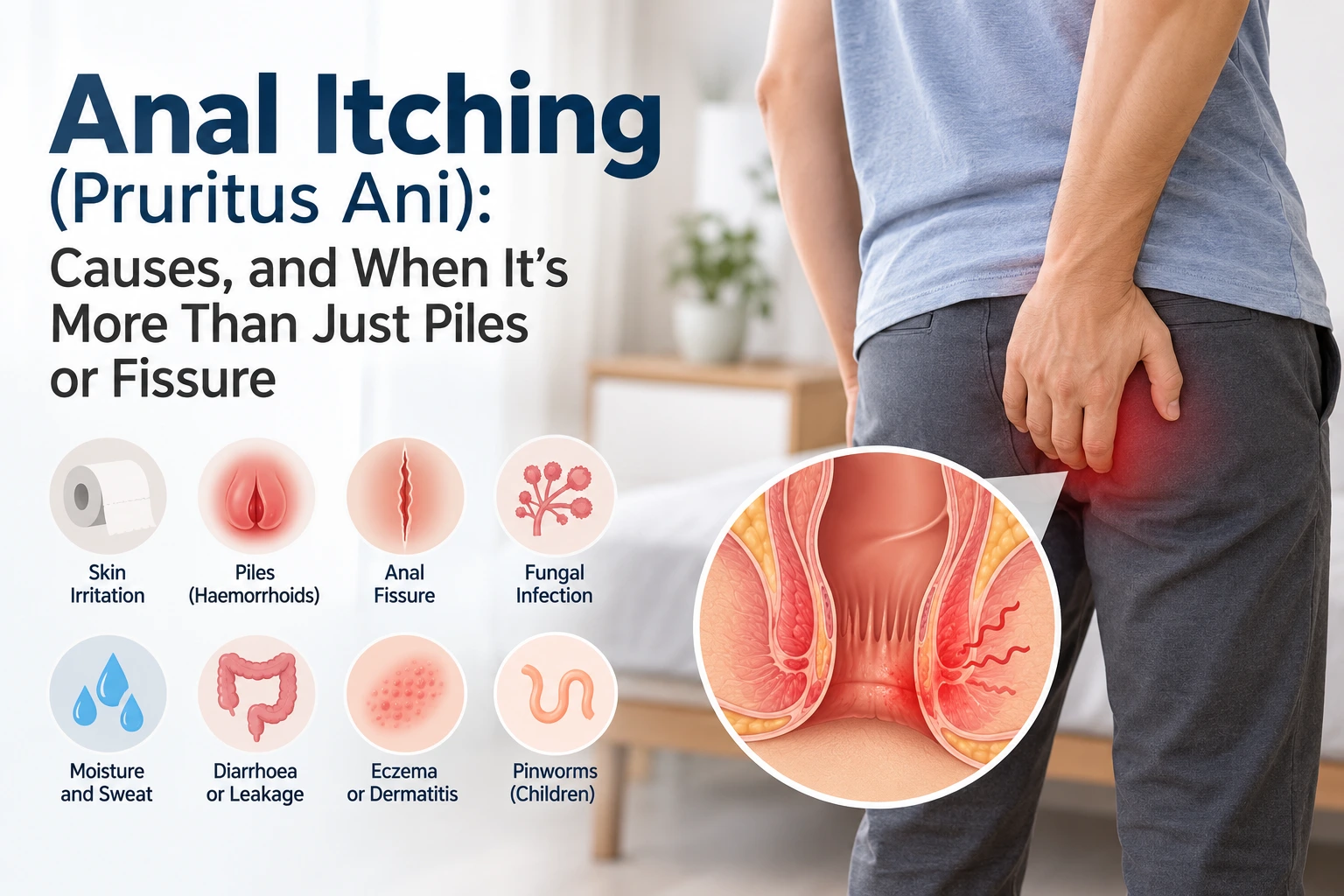
Anal Itching (Pruritus Ani): Causes, and When It’s More Than Just Piles or Fissure
Itching around the anus is one of those problems people tend to put up with quietly, hoping it will settle by itself. Sometimes it does, especially when the cause is simple skin irritation. But in other cases the itch keeps returning, and the reason may be piles, a small fissure, an infection or a skin condition that needs a completely different approach. Understanding the common anal itching causes can help you decide what is reasonable to try at home and when an examination makes more sense.
This guide explains what pruritus ani is, how its possible causes overlap, what gentle self-care involves, and when to get checked. It is written for readers in Wilson Garden and across Bangalore. It is general information, not a diagnosis.
What Is Anal Itching (Pruritus Ani)?
Pruritus ani is the medical term for itching of the skin around the anal opening. It is a symptom, not a diagnosis, much as a cough is not a diagnosis. Some people notice only a mild, nagging itch. Others describe itching and burning around the anus, redness, soreness or a raw feeling, often after bowel movements or at the end of a warm, sweaty day.
Symptoms commonly worsen with moisture, tight clothing, friction or repeated wiping. Doctors may also use the terms perianal itching or anal skin irritation, which mean much the same thing. How the itch feels does not reveal what is causing it, which is why the same complaint can come from very different problems.
What Are the Common Anal Itching Causes?
Most itching around anus causes fall into a few broad groups. They are not equally common, and more than one can be present at once.
- Skin irritation from over-cleaning: Scrubbing, harsh or scented soaps, perfumed wipes and frequent wiping can strip the skin’s natural protection and trigger itching.
- Moisture, sweat and friction: A warm, damp area under synthetic clothing can irritate delicate skin, especially in Bangalore’s humid months.
- Residual stool, diarrhoea or leakage: Even tiny traces of stool, or frequent loose motions, can irritate the skin. Mucus leakage can do the same.
- Piles (haemorrhoids): Swollen tissue can make thorough cleaning harder and sometimes allows mucus to seep out, causing haemorrhoids and anal itching to appear together.
- Anal fissures: A small tear in the anal lining may itch as it heals, though pain during bowel movements is usually the main complaint.
- Fungal and other skin infections: These can cause redness, irritation and itching, but they are not diagnosed from itching alone.
- Eczema and contact dermatitis: Perianal dermatitis can develop from allergies, irritants or a pre-existing skin condition.
- Pinworms: Threadworm infection is more typical in children or in households where someone has been affected.
- Less common causes: Some skin disorders and other anorectal conditions can also be responsible, which is one reason ongoing symptoms deserve assessment.
None of these can be reliably told apart by symptoms alone.
Anal Itching: Piles or Fungal Infection?
This is one of the most common questions patients ask. The honest answer is that itching alone cannot tell you. Anal itching piles or fungal infection, or fissure, or simple irritation, all produce overlapping symptoms.
Some general patterns exist, but they are not diagnostic rules:
- Piles may come with a soft lump, swelling, bleeding, mucus or a feeling of fullness.
- Fissures often cause sharp pain during or after a bowel movement and sometimes a streak of bright red blood.
- Fungal infections may cause a red, irritated or spreading rash, but appearance alone is not always enough to confirm one.
- Skin irritation often follows moisture, friction, harsh soaps or frequent wiping.
Itching can also occur with more than one of these at the same time. If the cause is unclear or symptoms persist, a clinical examination is far more reliable than guessing. Treatment aimed at the wrong cause can make things worse. You can read more about the conditions themselves on our piles and anal fissure pages.
Why Does Anal Itching Get Worse at Night?
Anal itching at night is very common, and it does not point to one single cause. Warmth under bedding, trapped moisture, irritated skin and simply having fewer distractions can all make the itch feel stronger when you lie down.
Pinworms are one possible explanation, particularly in children or when others at home have been affected. But night-time itching alone does not mean worms. Skin irritation, dermatitis, piles or a fissure can all feel worse at night.
If the itching keeps returning at night, disturbs your sleep, or comes with bleeding, a rash or discharge, it is worth having it assessed rather than relying on guesswork.
Pruritus Ani Treatment: What May Help?
Pruritus ani treatment depends entirely on the underlying cause, which is why identifying that cause matters. A clinician may recommend a combination of approaches, such as:
- Gentle cleaning with plain water, then patting the area dry rather than rubbing
- Avoiding fragranced soaps, wipes and other irritating products
- Keeping the area cool and dry
- Managing diarrhoea or stool leakage with appropriate medical guidance
- Treating a confirmed infection with the right medication
- Assessing and managing piles, fissures or skin conditions if they are present
There is no single cream or regimen that suits everyone. Using antifungal creams, steroid creams or antibiotics without a diagnosis can irritate the skin, hide the symptoms or delay the correct diagnosis. If the itch persists, a short examination can often clarify what is going on.
Itchy Anus Home Remedies: What Can You Safely Try?
Itchy anus home remedies work best as supportive care while you work out the cause. They can reduce irritation, but they cannot treat every underlying problem. Reasonable steps include:
- Cleaning gently with plain water and avoiding scrubbing
- Patting dry with a soft towel, or using a cool hairdryer setting at a distance if comfortable
- Wearing breathable cotton underwear and changing out of damp clothing
- Avoiding scented soaps, deodorants and perfumed wipes
- Resisting the urge to scratch, which can worsen the irritation
- Keeping bowel movements comfortable with fibre and enough fluids
- Thinking about whether a recently introduced soap, wipe or detergent could be the trigger
Please avoid inserting anything into the anus, applying undiluted essential oils, or using leftover or unprescribed medicated creams. If gentle care does not help within a couple of weeks, that is a sign to get examined.
What Causes Persistent Anal Itching?
Persistent anal itching, meaning itching that lasts longer than expected, keeps coming back or is getting worse, usually has an ongoing driver. That might be continuing skin irritation, an underlying skin condition, piles, a fissure, an infection, bowel leakage or something else that needs assessment.
A common pattern is the cycle of itch and scratch. Scratching damages the skin, which then itches more, so even a minor starting problem can become stubborn. Trying one cream after another without knowing the cause often prolongs this.
Persistent itching does not automatically mean something serious. But it is a good reason to ask for an examination rather than continue experimenting.
When Should You See a Doctor for Anal Itching?
Consider seeing a doctor if you have:
- Itching that persists or keeps returning
- Severe or worsening discomfort
- Rectal bleeding
- A painful lump or significant swelling
- Discharge, pus or a spreading rash
- New sores or skin changes
- Fever or feeling generally unwell alongside local symptoms
- Significant pain during bowel movements
- Symptoms that do not improve with gentle self-care
Heavy bleeding, severe pain, or rapidly worsening swelling with fever need prompt or urgent attention. These symptoms can have many causes, and a blog article cannot diagnose them. A short, private examination is the way to find out.
Anal Itching Consultation in Wilson Garden, Bangalore
If you are in Wilson Garden or elsewhere in Bangalore and have persistent itching, irritation, bleeding, anal pain or doubt about whether it is piles, a fissure or a skin infection, a qualified doctor can examine the area and guide next steps.
Dr. Srihari R. Shapur is a general surgeon (MBBS, MS in General Surgery) with a Fellowship in Endoscopy and a Diploma in Minimal Access Surgery, and his website lists coloproctology among the conditions he treats. He consults at ARC Cancer Hospital on Hosur Main Road, Wilson Garden , as well as Medax Hospitals in Gottigere . Patients in Wilson Garden, Bangalore, seeking surgical consultation can see the proctologist in Wilson Garden page for details, or read about the doctor’s profile . If a fistula or recurring abscess is a concern, see the anal fistula page.
Not every itch needs surgery, and many cases are managed without it. If your symptoms are persistent or worrying, getting them looked at is a sensible, unhurried step.
This article is for general education only and does not replace personal medical advice.
