Why Modern Surgeons Prefer Keyhole Surgery for Gallstones — and Why Indian Patients May Recover Faster
Why Modern Surgeons Prefer Keyhole Surgery for Gallstones — And Why Patients May Recover Faster
Gallstones are common, but when they begin causing repeated pain, inflammation or other complications, surgery may be recommended. Today, one of the most commonly performed approaches is laparoscopic gallbladder surgery , often called keyhole surgery.
For patients, the idea of surgery can naturally bring concerns about pain, hospital stay, scars and recovery time. Laparoscopic surgery has changed this experience for many patients by allowing surgeons to perform the procedure through a few small incisions rather than one larger abdominal incision.
Dr. Srihari explains that the decision to undergo surgery and the choice of surgical technique should always be based on the patient's individual condition, medical history and the nature of the procedure required.
What Are Gallstones?
Gallstones are hardened deposits that develop inside the gallbladder. They can vary in size and may not always cause symptoms. However, when a stone blocks the normal flow of bile, it can lead to symptoms such as:
- Pain in the upper right or upper middle abdomen
- Pain after eating, particularly after fatty meals
- Nausea or vomiting
- Bloating or indigestion
- Pain that may radiate towards the back or shoulder
In some cases, gallstones can cause complications such as gallbladder inflammation, bile duct obstruction or pancreatitis.
Not everyone with gallstones needs surgery. However, when gallstones become symptomatic or cause complications, gallbladder removal, known as cholecystectomy, may be advised.
What Is Keyhole or Laparoscopic Surgery?
Laparoscopic gallbladder surgery is a minimally invasive surgical technique used to remove the gallbladder.
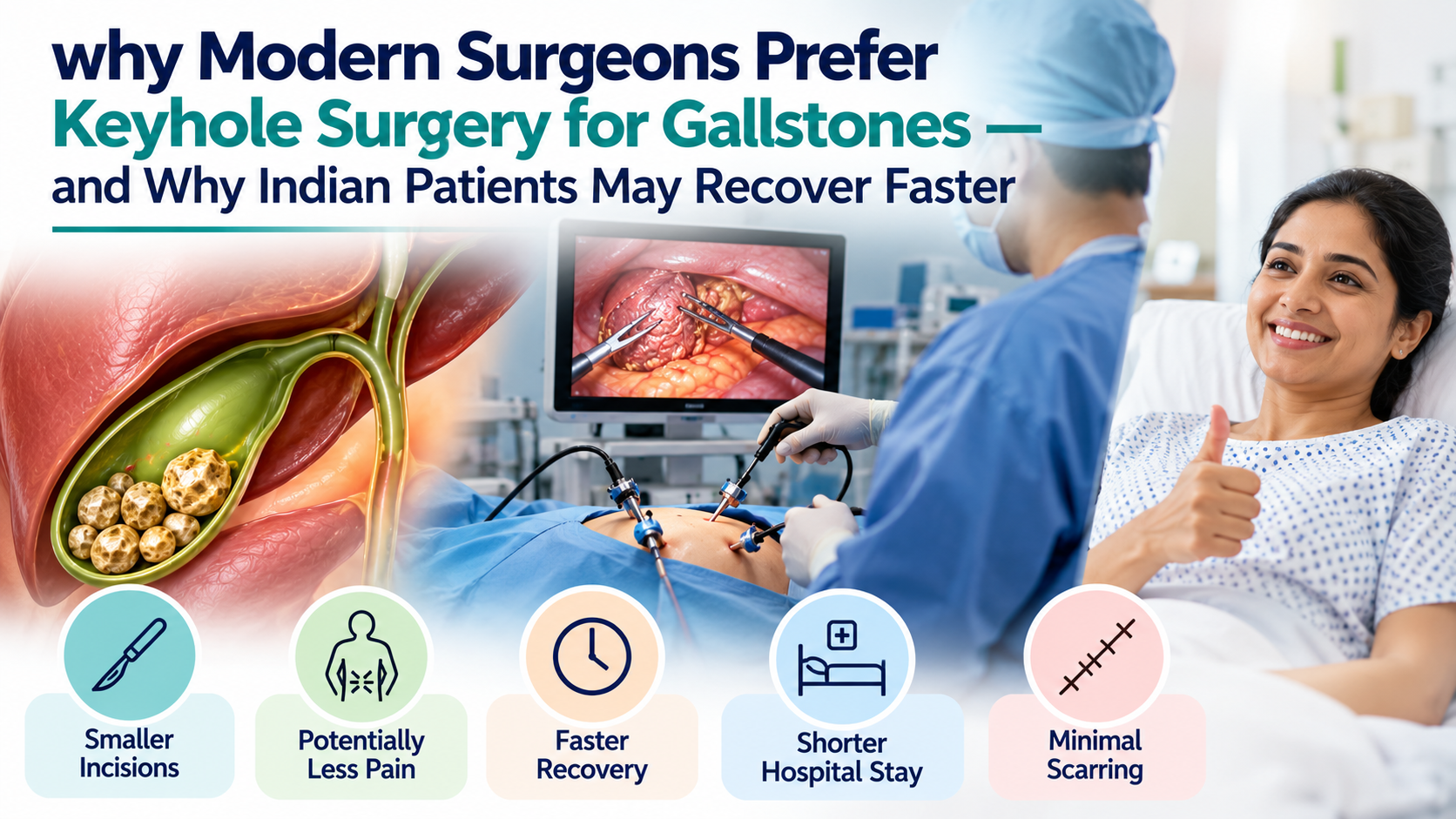
Instead of making one large incision, the surgeon generally makes several small incisions in the abdomen. A small camera, called a laparoscope, is inserted through one of these openings. The camera provides a magnified view of the surgical area, allowing the surgeon to perform the procedure using specialised instruments.
Once the gallbladder is safely separated, it is removed through one of the small incisions.
This approach is commonly referred to as keyhole surgery because the surgical access points are much smaller than those used in traditional open surgery.
Why Has Laparoscopic Surgery Become So Common?
The shift towards minimally invasive surgery is not simply about making smaller cuts. It is about achieving the surgical objective while minimising the physical impact of the procedure where appropriate.
For suitable patients, laparoscopic gallbladder surgery may offer several potential advantages.
1. Smaller Incisions
One of the most noticeable differences is the size of the surgical incisions.
Laparoscopic surgery generally involves several small openings instead of a larger abdominal incision. Smaller incisions can mean less disruption to the abdominal wall and may also result in smaller scars after healing.
2. Potentially Less Post-Operative Discomfort
Because laparoscopic surgery uses smaller incisions, some patients may experience less discomfort following surgery compared with traditional open surgery.
However, the amount of pain experienced can vary significantly from one patient to another and depends on several factors, including the individual's health, surgical findings and response to pain medication.
3. Earlier Return to Routine Activities
One of the reasons patients often prefer minimally invasive surgery is the possibility of a shorter recovery period.
Many patients undergoing uncomplicated laparoscopic gallbladder surgery can return to normal activities relatively quickly, although the exact recovery period differs from person to person.
The surgeon will provide specific guidance regarding work, exercise, lifting and other activities.
4. Minimal Scarring
For many patients, the cosmetic aspect of surgery is also important.
The small incisions used during laparoscopic surgery typically result in smaller scars compared with a conventional open operation. Over time, these scars may become less noticeable as they heal.
5. Shorter Hospital Stay in Many Cases
Laparoscopic gallbladder surgery is often associated with a shorter hospital stay compared with open surgery, particularly when the procedure is straightforward and the patient recovers well.
In selected cases, patients may be able to go home relatively soon after surgery following appropriate observation and assessment.
Is Laparoscopic Surgery Suitable for Everyone?
This is an important question.
Although laparoscopic surgery is widely used for gallbladder removal, the same surgical approach may not be appropriate for every patient.
The decision can depend on factors such as:
- The severity of gallbladder disease
- Previous abdominal surgeries
- Anatomical considerations
- Acute inflammation or infection
- Other underlying medical conditions
- The surgeon's assessment during the procedure
In certain situations, a surgeon may recommend open surgery from the beginning. In other cases, a laparoscopic procedure may need to be converted to an open procedure if continuing laparoscopically would not be considered safe.
The priority is always patient safety and effective treatment, rather than simply choosing the smallest incision.
The Importance of the Right Surgical Evaluation
A diagnosis of gallstones does not automatically mean that surgery is required.
Patients need an appropriate evaluation to understand whether their symptoms are actually related to gallstones and whether gallbladder removal is indicated.
Depending on the situation, evaluation may include a clinical examination, ultrasound imaging and blood tests. Additional investigations may be recommended when necessary.
Dr. Srihari emphasises the importance of individualised surgical planning, because every patient presents differently. The goal is not simply to perform a minimally invasive procedure, but to determine the safest and most appropriate treatment for that particular patient.
What Can Patients Expect After Laparoscopic Gallbladder Surgery?
After surgery, some patients may experience mild abdominal discomfort, bloating or temporary digestive changes. These symptoms generally improve as recovery progresses.
Patients are usually advised to gradually return to normal activities according to their surgeon's instructions.
Recovery can vary depending on the patient's overall health, the complexity of the surgery and whether there were complications.
Following post-operative instructions, attending follow-up appointments and promptly reporting unusual symptoms are important parts of recovery.
When Should You See a Doctor?
Gallstone symptoms should not be ignored, particularly when they are recurrent or severe.
Seek medical attention if you experience persistent or severe abdominal pain, fever, repeated vomiting, jaundice or other concerning symptoms.
Early evaluation can help determine whether the symptoms are due to gallstones and whether treatment is necessary.
A Patient-Centred Approach to Gallstone Surgery
Modern surgery is increasingly focused not only on treating the disease but also on helping patients recover with as little unnecessary physical disruption as possible.
Laparoscopic gallbladder surgery represents an important advancement in this approach. For appropriate patients, smaller incisions, potentially less post-operative discomfort, shorter hospital stays and faster return to routine activities can make the surgical experience more manageable.
However, minimally invasive does not mean risk-free, and laparoscopic surgery is still a major surgical procedure. The right approach depends on the patient's condition and the surgeon's clinical judgement.
With careful evaluation and appropriate surgical planning, patients can better understand their treatment options and make informed decisions about their gallbladder health.
Dr. Srihari believes that every surgical decision should be guided by the patient's individual needs, safety and long-term well-being. If you have been diagnosed with gallstones or are experiencing recurring abdominal pain, consult a qualified surgeon to understand whether treatment is required and which surgical approach may be appropriate for you.
Key Takeaway
Gallstone surgery has evolved. With laparoscopic or keyhole surgery, many suitable patients may benefit from smaller incisions, less post-operative discomfort, minimal scarring and a potentially faster recovery. But the best surgical approach is always the one that is safest and most appropriate for the individual patient.
