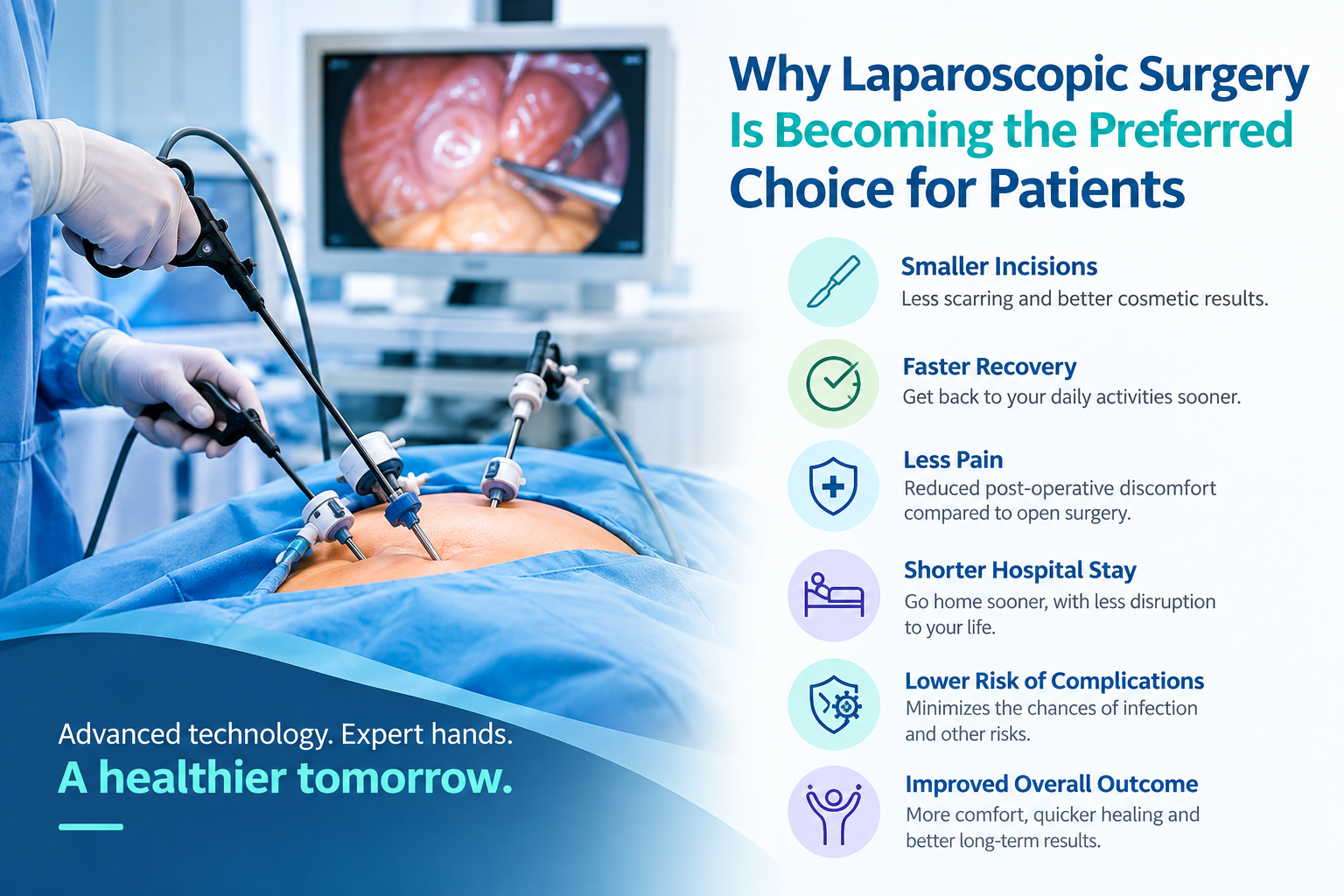
Why Laparoscopic Surgery Is Becoming the Preferred Choice for Patients
By Dr. Srihari R. Shapur
General & Laparoscopic Surgeon, Bangalore
A patient once asked me, half-jokingly, why I needed a camera and three small ports to do what surgeons traditionally did through a much larger incision.
My answer was simple: the big incision was never the goal. It was the surgical approach available to us at the time. As technology and surgical techniques have evolved, minimally invasive surgery has given surgeons another way to achieve the same surgical objectives while potentially reducing the trauma associated with a large incision.
Today, laparoscopic surgery, also known as keyhole or minimally invasive surgery, has become an established approach for many surgical procedures. For appropriately selected patients, it can offer several advantages, including smaller incisions, less postoperative discomfort, reduced blood loss, shorter hospital stays and a potentially faster return to normal activities.
As a surgeon, I believe the conversation around surgery should therefore begin with an important question:
Can this procedure be safely and effectively performed using a minimally invasive approach for this particular patient?
The answer is not always yes. But it is a question worth asking.
What Does Laparoscopic Surgery Actually Change for the Patient?
The term "keyhole surgery" is now widely understood, but patients often want to know what it actually means for them.
In laparoscopic surgery, the surgeon performs the procedure through a few small incisions rather than one large open incision. A laparoscope—a thin instrument equipped with a camera—is inserted through one of these openings and provides a magnified view of the surgical area on a monitor. Specialised surgical instruments are introduced through additional small ports.
The objective is not simply to make smaller cuts. The broader goal is to perform the required surgery effectively while minimising unnecessary disruption to surrounding tissues, whenever the patient's condition and the procedure make this approach appropriate.
That difference can have a meaningful impact on the patient's experience before, during and after surgery.
Smaller Incisions and Less Tissue Trauma
One of the most obvious advantages of laparoscopic surgery is the size of the incisions.
Traditional open surgery may require a relatively large incision to provide the surgeon with adequate access to the surgical area. Laparoscopic surgery, in contrast, generally uses several smaller openings.
Smaller incisions can mean less disruption to the abdominal wall and surrounding tissues. For many patients, this can contribute to reduced postoperative discomfort and a lower requirement for pain medication during recovery.
For a patient, even this seemingly simple difference can make the first few days after surgery more manageable.
Reduced Blood Loss
Another potential advantage of minimally invasive surgery is reduced blood loss in many procedures when compared with comparable open approaches.
This can be an important consideration, particularly when treating patients for whom blood loss may carry additional risks. However, blood loss varies according to the procedure, the complexity of the surgery, the patient's condition and several other clinical factors.
It is therefore important not to assume that every laparoscopic procedure will involve the same degree of blood loss or carry identical benefits.
Shorter Hospital Stay
For many laparoscopic procedures, patients may be able to leave the hospital sooner than they would following comparable open surgery.
A shorter hospital stay can have benefits beyond convenience. Patients can continue their recovery in familiar surroundings, while reducing the disruption that surgery can cause to family responsibilities, work and everyday life.
However, the length of hospitalisation depends on the type of surgery, the patient's overall health, postoperative recovery and whether any complications occur.
Faster Return to Daily Activities
For patients, recovery is about much more than simply being discharged from the hospital.
They want to know when they can walk comfortably, return to work, resume household activities, care for their families and return to the routines that are important to them.
Because laparoscopic surgery generally involves smaller incisions and less tissue disruption, appropriately selected patients may experience a quicker recovery compared with open surgery. The actual recovery period varies considerably depending on the procedure and the individual patient.
This is why patients should always ask their surgeon what recovery is likely to look like in their specific case rather than relying on general timelines.
Smaller Scars
Smaller incisions also generally mean smaller scars.
For many patients, this is an important consideration. It may be particularly relevant for younger patients or individuals concerned about visible surgical scars.
But the importance of smaller scars is not purely cosmetic. Knowing that a procedure may be performed through smaller incisions can also give patients greater confidence as they move through the recovery process.
Laparoscopic Surgery in Gynaecology and Urology
Minimally invasive surgery has become an established part of modern surgical practice across several specialties.
In gynaecology, laparoscopic hysterectomy is an important minimally invasive option for appropriately selected patients. Depending on the patient's condition, anatomy and the complexity of the procedure, the uterus may be removed through small keyhole incisions rather than through a large abdominal incision.
Similarly, in urology, laparoscopic nephrectomy is an established minimally invasive approach for removing a kidney in appropriately selected cases.
The important point is that the availability of laparoscopic surgery does not mean that every patient should automatically undergo it.
The surgical approach should be selected after considering the patient's diagnosis, anatomy, previous surgeries, medical history, overall health and the complexity of the condition.
Is Laparoscopic Surgery Always the Better Option?
This is one of the most important questions patients should ask.
The answer is no—not every patient and every surgical condition is suitable for laparoscopic surgery.
There may be circumstances in which open surgery is more appropriate. Previous operations, extensive adhesions, complex anatomy, advanced disease, certain medical conditions or unexpected findings may influence the choice of surgical approach.
In some situations, a surgeon may also need to change from a laparoscopic approach to an open procedure during surgery if doing so is considered necessary for the patient's safety or to achieve the desired surgical outcome.
This is why I believe patients should not approach surgery with the assumption that laparoscopic surgery is automatically better simply because it is newer or less invasive.
The more useful question is:
“Is a minimally invasive approach safe and appropriate for my particular condition?”
That decision should be made through a detailed discussion between the patient and the surgeon.
Where Is Minimally Invasive Surgery Heading?
The evolution of minimally invasive surgery is continuing.
Single-incision laparoscopic surgery aims to perform selected procedures through a single access point, potentially reducing the number of visible scars.
Other techniques, including natural orifice surgical approaches, are also being explored and developed for specific clinical applications.
At the same time, robotic-assisted surgery is expanding the possibilities of minimally invasive procedures in selected cases. Robotic platforms can provide features such as enhanced three-dimensional visualisation, greater instrument dexterity and improved control, which may be particularly useful during certain complex procedures.
However, technology should always remain a means to an end.
A sophisticated surgical platform cannot replace clinical judgment, surgical experience, appropriate patient selection or good postoperative care.
Technology Matters. But the Surgeon Matters More.
One of the most important things I tell patients is that technology alone does not determine the outcome of surgery. A laparoscopic camera, specialised instrument or robotic platform is ultimately a tool. The value of that tool depends on how appropriately it is used, the surgeon's experience, careful patient selection and the overall quality of surgical and postoperative care.
For this reason, patients should ask more than simply:
“Can this surgery be done laparoscopically?”
They should also ask:
- Is laparoscopic surgery appropriate for my particular condition?
- How frequently is this procedure performed using a minimally invasive approach?
- What are the potential benefits and risks in my case?
- What can I expect during recovery?
- Are there circumstances in which an open procedure may be necessary?
- What should I do to prepare for surgery and recovery?
These questions help patients become active participants in their own healthcare decisions.
The Future of Surgery Is Less Invasive—and Patient-Centred
The shift from large open incisions to minimally invasive techniques is an important advancement in modern surgical care.
The goal of laparoscopic surgery is simple: achieve the desired surgical outcome while minimising unnecessary trauma whenever it is safe and appropriate.
For many patients, this can mean smaller incisions, less discomfort, shorter hospital stays and a faster return to daily life.
However, laparoscopic surgery is not right for everyone. The best approach depends on the patient's condition, anatomy, medical history and overall health.
If you are considering surgery, ask your surgeon whether a minimally invasive approach is appropriate for you—and, most importantly, why it is the right choice for your condition.
