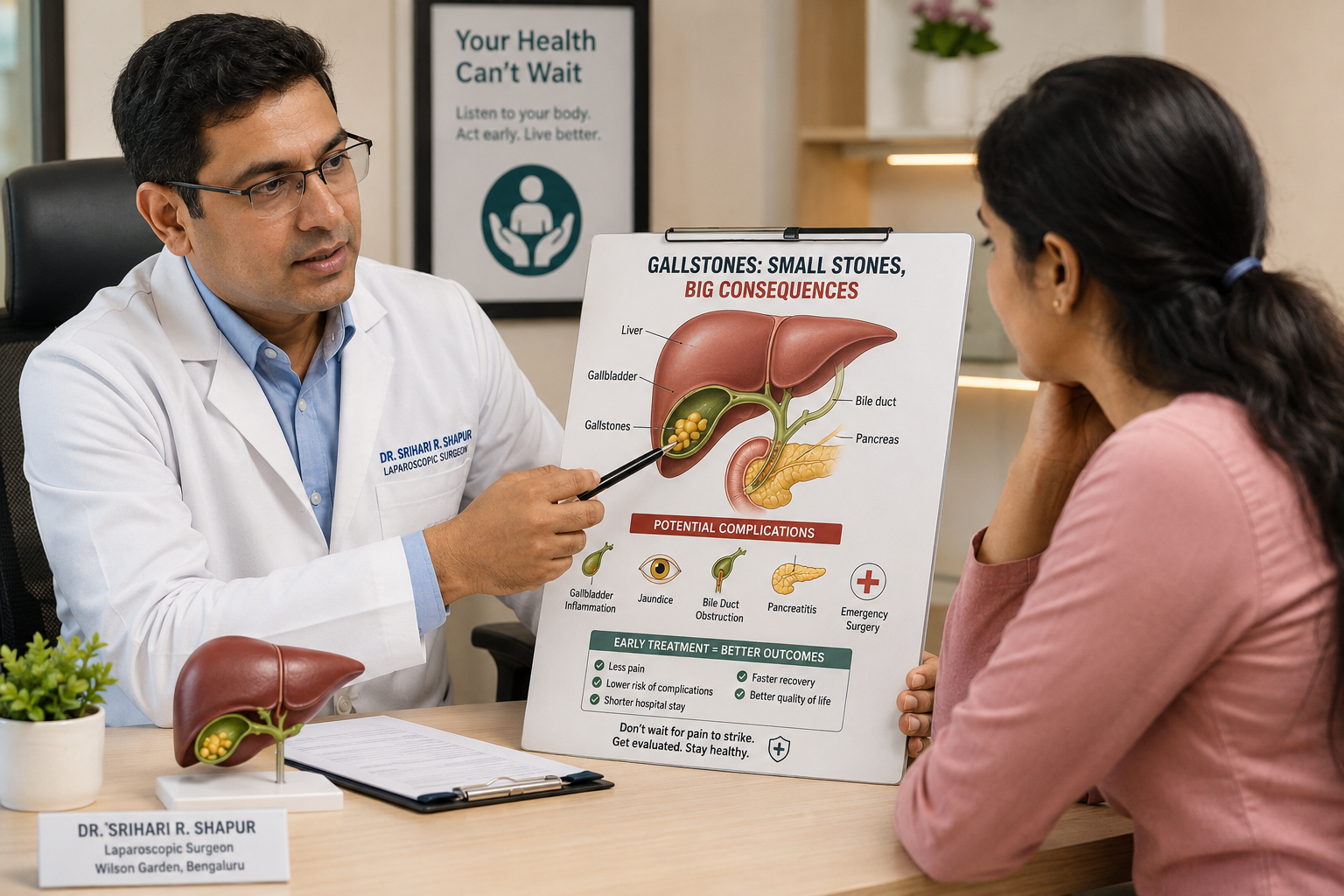
When Gallstones Go Silent: The Hidden Cost of Waiting Too Long
"The pain stopped, so I thought the problem had gone away."
It's a sentence Dr. Srihari R. Shapur hears far too often.
As a General & Laparoscopic Surgeon with over 14 years of overall experience, he has treated countless patients who ignored what seemed like "just another stomach ache." For many, the pain appeared after a heavy meal, lingered for a few hours, and disappeared on its own. Relieved, they returned to their normal lives, until the next episode arrived, often more painful than the last.
"The biggest misconception people have is that if the pain disappears, the gallstones have disappeared too," says Dr. Srihari. "Unfortunately, gallstones don't work that way. The symptoms may settle temporarily, but the condition can continue to progress silently."
This is precisely why gallstones are often called a silent threat. The danger isn't always the pain you experience today, it's the complications that may develop tomorrow if the condition is left untreated.
A Small Organ. A Surprisingly Big Impact.
The gallbladder is a small, pear-shaped organ located beneath the liver. Its role is simple: store bile, a digestive fluid that helps break down fats. However, when cholesterol, bile pigments, or other substances harden, they form gallstones.
Many people have gallstones without knowing it. In fact, not every gallstone requires surgery. But once symptoms begin, especially repeated pain, the condition deserves careful medical evaluation.
According to Dr. Srihari, one of the most common mistakes patients make is confusing gallstone pain with acidity, gas, or indigestion.
"Patients often tell me they've been treating themselves with antacids for months because the discomfort comes and goes," he explains. "By the time they seek medical attention, the gallbladder may already be inflamed."
Recognising the difference early can prevent unnecessary suffering and more complex treatment later.
When Waiting Turns a Treatable Condition into an Emergency
Gallstones don't always worsen gradually. Sometimes, they remain quiet for months before suddenly blocking the bile duct or causing severe inflammation.
When this happens, the consequences can be serious.
An untreated gallstone can lead to acute cholecystitis (inflammation of the gallbladder), obstructive jaundice, cholangitis (infection of the bile ducts), or even acute pancreatitis, a potentially life-threatening inflammation of the pancreas.
These complications often require emergency hospitalisation and urgent surgical intervention.
"In clinical practice, I frequently see patients who delayed consultation because the pain subsided after a few hours," says Dr. Srihari. "Unfortunately, many return months later with complications that could have been prevented through timely diagnosis and planned treatment."
The difference between elective surgery and emergency surgery is often nothing more than the decision to seek medical advice early.
Common Myths That Delay Treatment
One of the reasons gallstones are frequently neglected is the number of myths surrounding them.
"If I avoid oily food, the problem will disappear."
Dietary changes may reduce the frequency of painful attacks, but they do not remove existing gallstones.
"The pain comes only once in a while, so it isn't serious."
Intermittent pain does not necessarily mean a mild condition. Even occasional symptoms can indicate that gallstones are obstructing the normal flow of bile.
"Painkillers solve the problem."
Pain medication may provide temporary relief, but it treats the symptom, not the underlying cause.
As Dr. Srihari explains, "The goal isn't simply to stop the pain. It's to understand why the pain is occurring and prevent complications before they develop."
The Questions Patients Ask Most Often
One question Dr. Srihari hears almost every day is:
"Can I live with gallstones if the pain isn't constant?"
The answer depends on the individual patient. Not every gallstone requires immediate surgery, but symptomatic gallstones should never be ignored. The decision is based on factors such as the patient's symptoms, imaging findings, overall health, and risk of future complications.
Another common concern is surgery itself. Fortunately, advances in minimally invasive surgery have transformed the patient experience.
Today, laparoscopic cholecystectomy, performed by a Gallbladder Stone Surgery Specialist in Gottigere, is considered the gold standard for treating symptomatic gallstones. Performed through a few small keyhole incisions using a high-definition camera and specialised instruments, it offers significant advantages over traditional open surgery.
Patients typically experience less pain, minimal scarring, reduced risk of infection, shorter hospital stays, and a quicker return to their daily routine.
Why Experience Matters
Technology plays an important role in modern surgery, but experience plays an even greater one.
At Medax Hospitals, Gottigere, Bengaluru, Dr. Srihari R. Shapur specialises in advanced laparoscopic surgery, with expertise in Gallbladder Stone Surgery in Gottigere, hernia repair, appendix surgery, and a wide range of gastrointestinal laparoscopic procedures. Backed by over 14 years of overall experience, his approach combines surgical precision with compassionate, patient-centred care.
Every treatment plan begins with understanding the patient's condition, explaining all available options, and recommending the most appropriate course of action rather than adopting a one-size-fits-all approach. His focus on minimally invasive techniques allows eligible patients to benefit from safer procedures, smaller incisions, faster recovery, and an earlier return to normal life.
Listen to the Pain Before It Stops
One of the greatest mistakes people make is believing that the absence of pain means the absence of disease.
Gallstones rarely disappear on their own. What disappears is often only the warning sign.
If you've experienced recurring pain in the upper abdomen, discomfort after meals, nausea, or unexplained digestive symptoms, don't wait for another painful episode to convince you that something is wrong.
Early diagnosis not only prevents complications but also allows treatment to be planned under safer, more controlled circumstances.
As Dr. Srihari often reminds his patients, "It's always better to treat gallstones before they become an emergency than after they have already caused one."
Your gallbladder may be small, but delaying treatment can have consequences far greater than you expect.
When it comes to gallstones, the real cost isn't the surgery, it's waiting until surgery becomes your only choice.
