When Does a Hernia Actually Need Surgery? Watchful Waiting vs Surgical Repair
If you've just been told you have a hernia, or you've noticed a lump yourself, the first question is almost always the same: do I need surgery, and if so, how soon? It's a fair question, and the honest answer is: it depends. Some hernias can be watched safely for a while under medical guidance. Others need planned surgical repair within weeks or months. A smaller number need urgent attention the same day. Understanding when is hernia surgery necessary — and when it genuinely isn't yet — helps you make a calmer, better-informed decision instead of an anxious or a careless one.
This article walks through how doctors actually think about hernia timing, so you know what questions to ask at your next consultation.
What Is a Hernia?
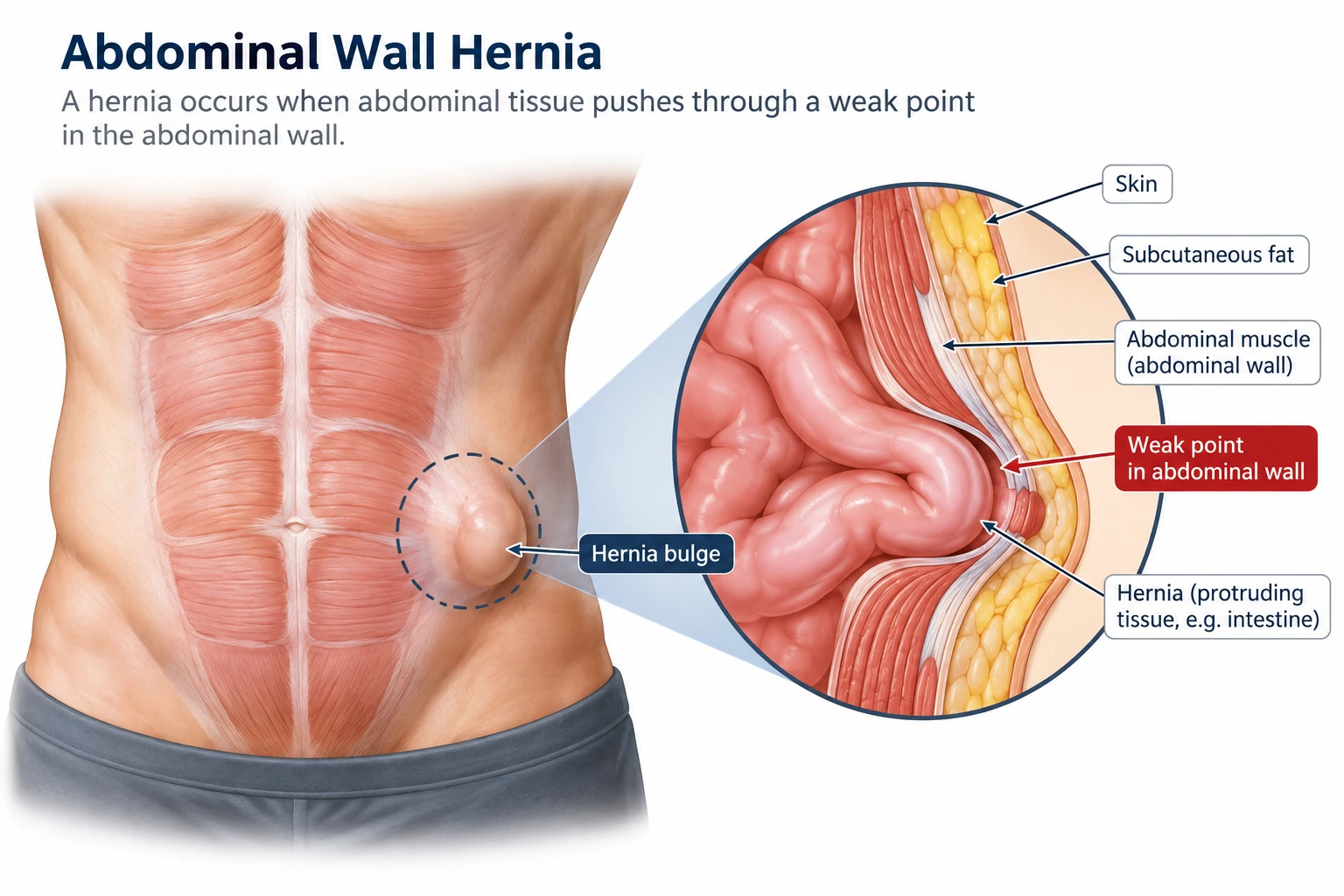
A hernia occurs when an internal organ or fatty tissue pushes through a weak point in the surrounding muscle or connective tissue, usually in the abdominal wall. The weak spot itself doesn't go away on its own — it's essentially a gap in a wall that keeps things where they belong.
Common types include:
- Inguinal hernia – in the groin, the most common type in adults, particularly men
- Umbilical hernia – around the belly button
- Incisional hernia – at the site of a previous surgical scar
- Femoral hernia – lower in the groin, more common in women
- Hiatal hernia – involving the upper stomach, which behaves differently from abdominal wall hernias
Typical symptoms include a visible or palpable bulge, a dragging or aching sensation, discomfort with coughing, lifting or straining, and a lump that may appear or enlarge with activity and settle down with rest. Some people have no symptoms at all and discover the hernia during a routine check-up.
When Is Hernia Surgery Necessary?
Hernia surgery is generally considered necessary when the hernia is causing persistent symptoms, is increasing in size, is becoming difficult or impossible to push back in, or shows signs that could lead to a complication. Surgery may also be appropriate when a hernia limits daily activity, work, or exercise, even if it isn't dangerous yet.
That said, not every hernia reaches this point immediately. A small, painless hernia that is easily reducible and stable over time may sometimes be managed initially through observation, particularly in older adults with other health conditions where surgical risk needs careful weighing against the risk of leaving it alone. The decision isn't based on one factor — it's based on the whole clinical picture, including the type of hernia, its size, whether it can be pushed back, how it's changing over time, and how it affects your life.
This is why two people with what looks like "the same" hernia can be given different advice. It isn't inconsistency — it's individualised care.
Can Hernia Be Treated Without Surgery?
A hernia does not repair itself permanently through medication, exercises, or lifestyle changes, because the underlying defect in the abdominal wall doesn't close on its own. What non-surgical measures can sometimes do is reduce symptoms or slow progression — not fix the actual gap.
For a small number of minimally symptomatic hernias, a doctor may recommend observation rather than immediate repair. This is a considered medical decision, not a substitute for treatment. Supportive measures such as weight management, treating chronic cough or constipation, and avoiding heavy straining can ease symptoms and may reduce strain on the weak area, but they do not close the defect itself.
It helps to separate two different things:
- Symptom management — reducing discomfort day to day
- Permanent repair — surgically closing the weakened area, usually with sutures or mesh reinforcement
The first is sometimes possible without an operation. The second currently is not.
What Is Hernia Watchful Waiting?
Hernia watchful waiting means monitoring a hernia over time with scheduled follow-up instead of proceeding straight to surgery, used only in carefully selected situations rather than as a default approach.
It's generally considered when the hernia is:
- Small and minimally symptomatic
- Reducible, meaning it can be gently pushed back in
- Stable, without evidence of rapid growth
- Not showing any signs of obstruction or compromised blood supply
Someone on a watchful waiting plan is usually asked to track a few things: whether the lump is changing in size, whether pain is increasing, whether it's getting harder to push back, and whether new symptoms like nausea or bowel changes appear. Regular clinical review matters here — this isn't a one-time decision, it's an ongoing one.
Watchful waiting is not the same as ignoring a hernia. If symptoms progress, if the hernia becomes larger or less reducible, or if activity becomes limited, the plan usually shifts toward elective repair. The moment warning signs of a complication appear, observation is no longer appropriate at all.
Small Hernia: Do I Need Surgery?
Size alone doesn't decide whether a small hernia needs surgery — symptoms, reducibility, location, and how it behaves over time matter more than the measurement itself.
A small hernia can still cause meaningful pain, especially in certain locations such as the groin. Conversely, a somewhat larger hernia that is asymptomatic and stable may be observed for longer in the right patient. What tends to matter more than size includes:
- Whether it's painful or just noticeable
- Whether it reduces easily or feels increasingly tight
- Whether it's growing over weeks or months
- Whether it interferes with work, exercise, or sleep
- Any personal risk factors, such as chronic cough, heavy physical labour, or a prior hernia repair at the same site
A clinical examination is the only reliable way to weigh these factors together. Self-assessment based on size alone can be misleading in either direction.
Is Hernia Surgery Urgent?
Most hernia surgery is elective, meaning it's planned in advance rather than performed as an emergency. However, hernia surgery becomes urgent when there are signs of incarceration or strangulation, and in those cases, waiting is not safe.
It helps to think of three categories:
- Elective – the hernia is stable and reducible; surgery is scheduled at a convenient time after discussion
- Semi-urgent – symptoms are worsening, or the hernia is becoming harder to manage, warranting earlier assessment and often earlier surgery
- Emergency – the hernia is stuck, painful, and possibly compromising blood flow to the tissue inside it; this needs same-day medical evaluation
Many people live with a diagnosed, stable, reducible hernia for months while surgery is planned around their health status and schedule. That is normal and appropriate for a large proportion of cases. The exception is when red-flag symptoms appear, which are covered below.
What Are the Hernia Surgery Risks of Waiting?
Delaying elective hernia repair carries some risk of the hernia becoming larger, more symptomatic, or harder to reduce over time, though the pace and likelihood of this varies from person to person and from one hernia type to another.
Over time, a hernia that is left unaddressed may:
- Gradually increase in size
- Become more noticeably painful or uncomfortable
- Start to interfere more with daily movement or exercise
- Become harder to push back in
- Carry a higher chance, in some cases, of developing obstruction or strangulation
It's worth being clear here: this doesn't mean every hernia that isn't operated on quickly will develop a complication. Many stable, small hernias are monitored for extended periods without incident. But the risk isn't zero either, and it tends to increase — not decrease — the longer a symptomatic or enlarging hernia goes unrepaired. This is exactly why regular review matters when watchful waiting is chosen.
Strangulated Hernia Symptoms: When to Seek Emergency Care
Strangulation happens when the blood supply to the herniated tissue gets cut off, and it is a surgical emergency. Recognising the warning signs early can make a significant difference.
Seek immediate medical evaluation if you notice:
- Sudden or severe pain at the hernia site
- A lump that becomes firm, tender, or cannot be pushed back in
- Rapidly increasing swelling
- Nausea or vomiting
- Abdominal pain, bloating, or cramping
- Inability to pass stool or gas
- Fever
- Skin over the hernia turning red, dusky, or discoloured
If any of these appear, don't wait for a routine appointment — go to an emergency department or call for urgent medical help. These symptoms suggest the tissue inside the hernia may not be getting enough blood supply, and prompt surgical assessment is needed to prevent serious complications.
How Is Hernia Surgery Timing Decided?
Hernia surgery timing is decided by weighing the hernia's characteristics against the patient's overall health and daily life, rather than by a fixed rule that applies to everyone.
Factors that typically go into this decision include:
- Current symptoms and how much they affect daily function
- Size of the hernia and how quickly it's changing
- Type and anatomical location of the hernia
- Whether it's reducible or not
- Any history of prior abdominal surgery or previous hernia repair
- Overall health, including heart, lung, or metabolic conditions that affect surgical fitness
- Activity level and physical demands of work or lifestyle
- Findings on clinical examination, and imaging when it's needed
Elective repair is planned once symptoms, risk, and patient readiness align, and there's usually room for discussion about the best window for surgery. Emergency surgery, by contrast, is dictated entirely by the clinical situation in front of the surgeon at that moment — there is no window to plan around.
How Is a Hernia Diagnosed?
A hernia is usually diagnosed through a detailed medical history and a physical examination, where the doctor checks the swelling, assesses whether it's reducible, and often asks the patient to cough or strain to see how the bulge behaves.
In many straightforward cases, this clinical examination alone is enough to confirm a hernia and plan next steps. Imaging such as ultrasound or CT scan may be recommended in selected situations — for example, when the diagnosis is unclear, when symptoms don't match the examination findings, when there's a suspicion of complication, or before certain types of repair. Not every patient needs imaging; it's used to answer a specific clinical question when one exists.
What Are the Hernia Surgery Options?
Open Hernia Repair
Open repair involves a single incision directly over the hernia, through which the surgeon repositions the tissue and closes or reinforces the defect. It remains a well-established option, particularly in certain hernia types or specific patient circumstances.
Laparoscopic / Minimally Invasive Hernia Repair
Laparoscopic hernia surgery uses a few small incisions and a camera to guide the repair from inside the abdominal wall. In appropriately selected patients, this approach is associated with smaller scars and a quicker return to routine activity compared with open surgery.
Mesh Repair
Surgical mesh is often used to reinforce the weakened area and support the tissue as it heals, particularly for larger or recurrent hernias. Mesh use is decided based on the hernia type, size, and individual patient factors.
No single technique is universally the "right" choice for every hernia. The most suitable approach depends on the type of hernia, its location, the patient's health, and the surgeon's clinical judgment after examination.
What Are the Risks of Hernia Surgery?
Like any surgical procedure, hernia repair carries some general risks, though most patients recover without significant issues. These can include:
- Pain or swelling at the surgical site
- Infection
- Bleeding
- Recurrence of the hernia over time
- Nerve-related discomfort or numbness near the incision
- Reactions related to anaesthesia
- In uncommon cases, injury to nearby structures
The likelihood and nature of these risks vary depending on the type of hernia, the surgical technique used, and the patient's overall health. A pre-operative discussion with your surgeon is the appropriate place to go through your individual risk profile in detail.
Hernia Treatment in Wilson Garden, Bangalore
Patients looking for hernia treatment in Wilson Garden, Bangalore often begin with the same uncertainty covered in this article — whether their hernia needs surgery now, later, or not yet at all. That decision genuinely does depend on individual assessment, which is why a clinical evaluation matters more than searching for a generic answer online.
For residents of Wilson Garden and the wider South Bangalore area, having access to a general surgeon who specialises in hernia and laparoscopic repair means that both routine evaluation and, if needed, urgent surgical care are available close to home. Whether the appropriate path is continued monitoring, planned elective surgery, or urgent evaluation, a proper physical examination remains the starting point for any hernia-related decision in Bangalore.
When Should You See a Hernia Surgeon?
It's reasonable to book a consultation if you notice a new lump or bulge, ongoing discomfort at a hernia site, swelling that seems to be increasing, pain that shows up during activity or exercise, a lump that's becoming harder to push back in, or symptoms that keep recurring. It's also worth seeing a surgeon simply to get clarity if you're unsure whether your hernia needs surgery at all — that uncertainty is, by itself, a good enough reason for an examination.
Dr. Srihari R. Shapur is a General Surgeon and Laparoscopic Surgeon with a focus on hernia and coloproctology care, practising in Bangalore, including at Arc Cancer Hospital, Wilson Garden. A consultation typically involves a clinical examination, a discussion of your specific hernia type and symptoms, and a clear explanation of whether observation, elective repair, or urgent evaluation is the appropriate next step for your situation. If you notice any of the emergency symptoms described earlier in this article, seek immediate medical care rather than waiting for a scheduled appointment.
