Laparoscopic vs Open Hernia Repair: How to Choose
If you have been told you have a hernia, one of the first questions is often whether the repair should be laparoscopic or open. People researching laparoscopic vs open hernia repair in Bangalore will find many sources leaning toward one answer. In practice, the two approaches reach the hernia differently, and the suitable choice depends on the hernia's type and size, whether it is new or recurrent, previous operations, your general health, and the surgeon's assessment.
This guide explains how each approach works, what TEP and TAPP mean, what to understand about mesh and recurrence, and which questions to ask before consenting. It is general education, not advice for any individual, and it cannot replace an examination by a qualified surgeon.
What Is the Difference Between Laparoscopic and Open Hernia Repair?
The main difference is access. Open repair reaches the hernia through an incision near the affected area. Laparoscopic repair uses a camera and specialised instruments through several small incisions.
Open hernia repair
- The surgeon operates through an incision over or near the hernia.
- The defect is repaired with a technique chosen for the patient's condition. Mesh may be used where clinically appropriate, although some open repairs use the patient's own tissue.
- Depending on the case, the anaesthetic plan can range from local or regional to general anaesthesia.
Laparoscopic hernia repair
- A camera (laparoscope) and instruments pass through small incisions, and the surgeon works from a magnified view on a monitor.
- A recognised laparoscopic technique, such as TEP or TAPP, is used for the repair.
- Mesh is commonly used in laparoscopic inguinal hernia repair, depending on the repair plan.
- General anaesthesia is usually needed, and equipment, hospital stay and recovery may differ from open repair.
Both are established approaches. Neither is automatically right for every patient, and each fits some situations better than others.
Laparoscopic vs Open Hernia Repair in Bangalore: Which Is Suitable?
There is no single answer that applies to everyone. When surgeons weigh laparoscopic vs open hernia repair in Bangalore, as elsewhere, they usually consider:
- Hernia type and location: inguinal, femoral, umbilical, incisional and other hernias behave differently and may call for different repairs.
- Primary or recurrent hernia: a hernia that has already been operated on may be approached differently from a first-time hernia.
- Previous abdominal or pelvic surgery: scarring from earlier operations can make one approach more or less straightforward.
- One or both sides: some patients have hernias on both sides of the groin, which may influence the plan.
- Health and anaesthesia suitability: heart, lung and other conditions affect which anaesthetic and approach are safe.
- Recovery needs: your work, physical demands and home support are worth discussing, but they should not decide the procedure alone.
- Resources and experience: the surgeon's experience with a given technique, and the equipment available, matter.
- Risks, benefits and costs: these should be explained for your case, including possible additional charges.
A smaller incision, or a different recovery experience, is not by itself a reason to choose a procedure. For a general overview of keyhole surgery, including situations where it may not be suitable, see this article on laparoscopic surgery. A good consultation covers the options available to you and the reasons behind any recommendation.
TEP vs TAPP: Understanding Two Laparoscopic Hernia Repair Techniques
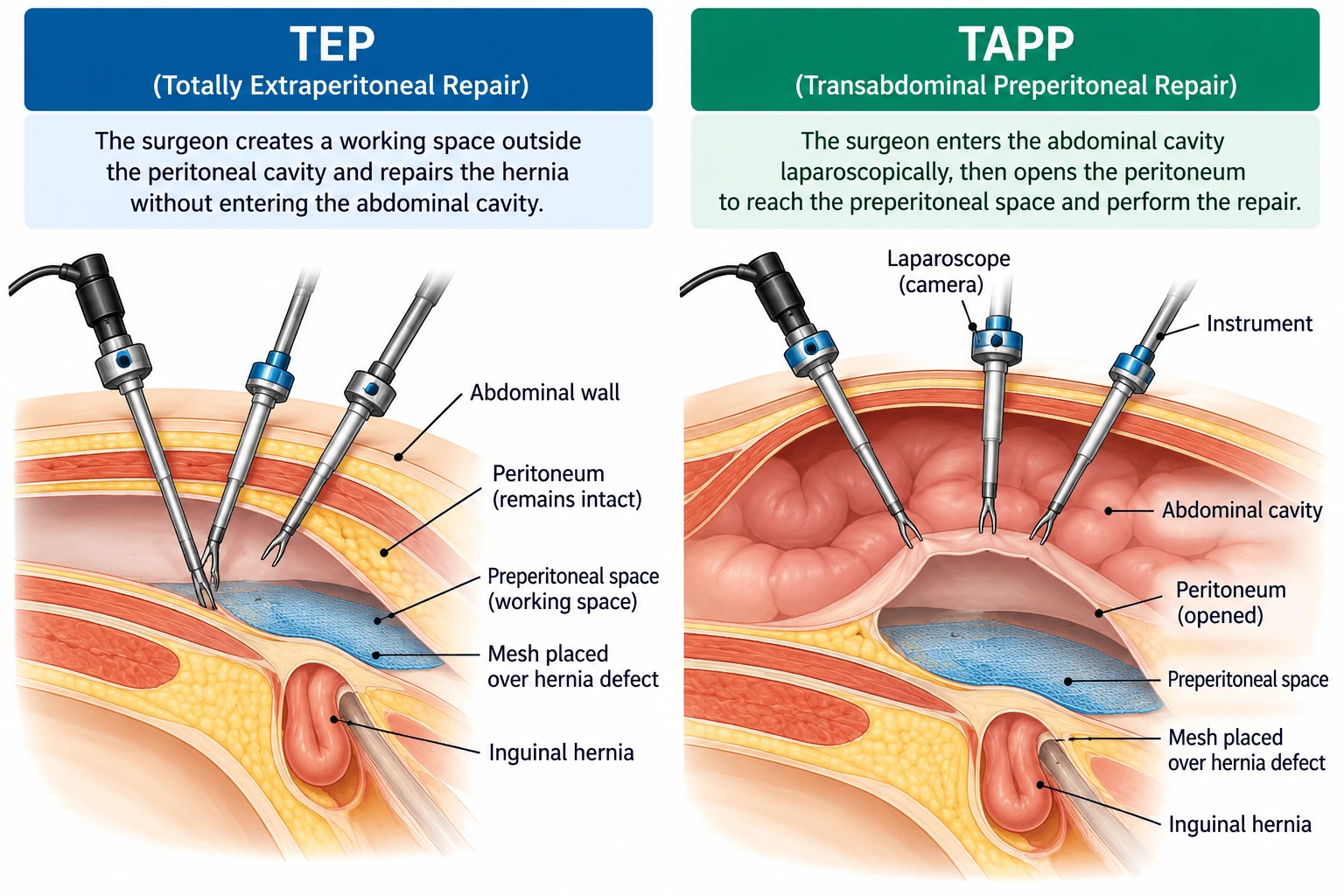
When people compare TEP vs TAPP, they are comparing two ways of doing laparoscopic inguinal hernia repair. Both place mesh in the preperitoneal space, the layer between the abdominal wall muscles and the peritoneum.
- TEP (Totally Extraperitoneal Repair): the surgeon creates a working space outside the peritoneal cavity and repairs the hernia without intentionally entering the abdominal cavity.
- TAPP (Transabdominal Preperitoneal Repair): the surgeon enters the abdominal cavity laparoscopically, then opens the peritoneum to reach the preperitoneal space and perform the repair.
| Feature | TEP | TAPP |
|---|---|---|
| Surgical access | Outside the peritoneal cavity | Through the abdominal cavity, then into the preperitoneal space |
| Working space | Created by the surgeon, and can be limited | Larger, with a wider view of the abdominal cavity |
| Technical considerations | Scarring from earlier lower abdominal or pelvic surgery can make dissection harder | Requires closing the peritoneum after mesh placement |
| Factors that may influence choice | Anatomy, previous surgery, hernia type, surgeon's experience | Anatomy, previous surgery, hernia type, surgeon's experience |
Both are used for selected inguinal hernias. Suitability depends on your anatomy, the hernia, previous operations, and the surgeon's assessment and experience. Neither is universally better.
Hernia Mesh Side Effects: What Should Patients Know?
Surgical mesh reinforces weakened tissue and is used in many hernia repairs. Whether it is used depends on the procedure and clinical circumstances. When discussing hernia mesh side effects, it helps to keep two points in mind: most patients do not experience serious problems, and complications can arise from the operation itself, not only from the mesh.
Possible issues after hernia surgery include:
- Pain or discomfort, which is usually temporary.
- Bruising, swelling or fluid collection near the wound.
- Wound infection.
- Bleeding or other surgical complications.
- Mesh infection or movement, which are possible but not inevitable.
- Scar tissue or other uncommon mesh-related problems.
- Persistent pain or recurrence in some patients.
Postoperative symptoms can have several causes, so they should not automatically be blamed on the mesh. Mesh is neither completely safe nor completely unsafe. Its risks and benefits need to be weighed for each person.
Before surgery, ask which type of repair is planned, whether mesh will be used, what the potential benefits and risks are, and what alternatives exist.
Recurrence After Hernia Surgery: Can a Hernia Return?
Recurrence means a hernia develops again at or near a previously repaired site. It can happen after both open and laparoscopic repair, and no technique removes the possibility entirely.
Factors that may contribute to recurrence after hernia surgery include:
- Hernia characteristics, such as size and complexity.
- Tissue quality and individual healing.
- Repair-related and technical factors.
- Wound infection or other complications.
- Smoking and certain medical conditions.
- Physical strain and postoperative activity, depending on the advice you are given.
No single factor always causes recurrence, and several may interact. If you notice a new bulge, persistent discomfort or returning symptoms after surgery, have it assessed by a qualified clinician. Treatment for a recurrent hernia is individualised, and the approach may differ from the first repair.
Recovery After Open and Laparoscopic Hernia Repair
Recovery varies between individuals and procedures. Some patients notice differences in early recovery depending on the approach, but no fixed timeline can be promised.
Areas your surgical team will usually address:
- Wound care: keeping the area clean and dry as instructed.
- Pain management: the medicines suggested and how to use them.
- Gradual return to activity: building up everyday activities step by step.
- Lifting, exercise and work: following the specific guidance you receive, which depends on your repair and your job.
- Follow-up: attending review appointments so healing can be checked.
- When to seek review: knowing which symptoms need medical attention.
Please avoid relying on general "return to work in X days" figures from the internet. Ask what is expected in your case.
Risks and Warning Signs After Hernia Surgery
Both approaches carry potential risks, and individual risk depends on the procedure and your circumstances. Seek prompt medical assessment for:
- Fever.
- Worsening redness, or discharge from the wound.
- Increasing pain.
- Persistent vomiting.
- Significant abdominal swelling.
Sudden severe pain, vomiting, or a painful, firm hernia bulge that cannot be pushed back in may need emergency assessment, particularly if symptoms are worsening. Do not delay urgent care while comparing procedures or prices.
Questions to Ask Before Choosing a Hernia Repair Method
- Which type of hernia do I have?
- Is open or laparoscopic repair appropriate in my case, and why?
- If laparoscopic repair is planned, would TEP or TAPP be considered?
- Will mesh be used, and what are its potential benefits and risks?
- What complications should I understand before consenting?
- What factors may affect my recurrence risk?
- What recovery instructions should I follow?
- What follow-up care will I need?
- What are the expected costs, and could there be additional charges?
The aim is an informed discussion, not steering you toward one procedure.
Hernia Surgeon in Bangalore: Understanding Your Treatment Options
A consultation with a qualified general surgeon can establish the diagnosis, review your medical history and previous operations, and explain suitable repair options along with their risks and recovery expectations. When looking for a Hernia Surgeon in Bangalore, it is reasonable to ask whether the surgeon examines you properly, explains the alternatives, and welcomes questions or a second opinion.
Dr. Srihari R. Shapur is a general and laparoscopic surgeon in Bangalore . His website lists an MS in General Surgery, a Diploma in Minimal Access Surgery, a fellowship in endoscopy and FIAGES. You can read about hernia treatment and the consultation locations on the site. Not every hernia needs immediate surgery, and not every hernia can be safely watched indefinitely, which is why examination matters. If you would like to talk through your options, you can review the consultation information or contact the clinic with your questions.
Conclusion
Open and laparoscopic hernia repair differ in surgical approach. TEP and TAPP are two laparoscopic techniques used in selected cases. Mesh-related complications and recurrence are worth discussing openly, but neither is inevitable. Before choosing, consider your hernia type, medical history, procedural options, risks and recovery needs. If you are weighing laparoscopic vs open hernia repair in Bangalore, a calm, unhurried conversation with a qualified surgeon is the most reliable next step. The clinic's consultation details are on the website if you wish to ask questions.
